
Hart County Deed Types
Every instrument the Hart County Clerk records adds a link to the public land trail. A deed names the grantor and the grantee. It also gives a description of the land and how the interest passed. Mortgages, liens, easements, restrictions, and releases are not deeds. Yet they can burden the same tract and sit in the same records. Type matters. A regular sale, an estate transfer, a court sale, and a correction each carry different legal weight. So the label deserves attention before anyone treats the paper as proof of ownership.
| Deed Type | What It Does | Common Use |
|---|---|---|
| Deed | Conveys the interest described in the instrument | Ordinary land transfer |
| Quitclaim deed | Conveys only the interest the grantor may have | Family transfer or title cleanup |
| Commissioner or sheriff deed | Records a court-directed or official sale | Estate, partition, or enforcement matter |
| Affidavit of descent | Places heirship facts in the land record | Death-related ownership trail |
| Correction instrument | Repairs a stated error in an earlier filing | Name or description correction |
Labels can mislead. A mortgage secures a debt; it does not convey the fee interest. Its matching release should be tracked down too. A lis pendens merely flags a pending lawsuit. A tax certificate is not a clean deed. Read the entire instrument, not just the heading. Conclude what it did to the land only then.
Hart County Deed Access
Hart County Clerk Felicia Shelton keeps the recorded real-estate instruments for the county. The office sits at 200 Main Street, P.O. Box 277, Munfordville, Kentucky 42765, and answers the phone at 270-524-2751. A visitor can search at the counter. Another option is to call ahead and confirm a reference. A focused written request by mail works too. The Clerk also handles requests filed under the Kentucky Open Records Act. That law opens another route when ordinary counter help is not enough.
Hart County Clerk
Current deeds, mortgages, plats, easements, liens, releases, and related recorded instruments.
200 Main Street, Munfordville
270-524-2751
KDLA Archives
Archival Hart deed holdings and request help for older records, including the 1928 through 1998 deed series.
When a counter or index question will not cover it, use the standard request form. Name the parties, the date range, the document type, and any book and page already known. The Clerk accepts the form by mail, fax, email, or hand delivery, and nonexempt records may be inspected or copied.
Search Fields for Hart Deeds
eCCLIX serves as the vendor for Kentucky clerk records. Its terms describe index and image access through an account. Hart County has no stable, unauthenticated deed search on its official pages. A missing web image only signals limited online access. It never means the Clerk lacks the permanent record, which remains on file in Munfordville.
| Search Route | Useful Input | Best Use |
|---|---|---|
| Party and date | Grantor or grantee name plus a date span | Finding transfers when no citation is known |
| Book and page | Exact reference from a deed or PVA card | Opening one known instrument |
| Document type | Deed, easement, plat, release, lien, affidavit | Narrowing a long party search |
Names come in many forms. Search spouses, trustees, fiduciaries, entity suffixes, and initials each way, and style a company grantee exactly as the deed spells it. When a book and page shows up on a prior instrument, use it before running a broad name search. Document type can surface a link a deed-only filter hides. eCCLIX categories include mortgages, assignments, releases, plats, restrictions, options, powers of attorney, affidavits, mechanic liens, tax liens, judgments, and wills. Pair a release with the mortgage it retires. Search a correction beside the document it repairs. Log the date filters and exact spellings so another researcher can repeat every result.
Follow Hart County Deed Chains
A chain of title is the ordered run of conveyances for one piece of land. Begin with the newest deed and walk backward through the owners. A good search log captures the executed date, recorded date, grantor, grantee, deed type, book and page, consideration, legal description, prior citation, and any exception or easement. The legal description is the strongest link. Street names and parcel numbers change over time, but that description holds the chain together.
- Find the current holder's acquiring deed by searching that owner as grantee.
- Read the grantor and any prior-deed citation from the full instrument.
- Search that grantor as a grantee to locate the earlier acquisition.
- Repeat while matching acreage, calls, roads, streams, adjoining owners, and survey references.
- Grantor
- The party conveying an interest.
- Grantee
- The party receiving that interest.
- Chain of title
- The linked sequence of instruments for one tract.
- Book and page
- A location reference within recorded volumes.
- Instrument number
- A filing identifier assigned to a recorded document.
KDLA recommends checking both the grantor and the grantee indexes. Commissioner and sheriff deeds may be filed apart from ordinary deeds. A deed-only search can miss a court-directed transfer. Since roughly 1890, deeds tend to cite the prior recording. Older chains may need tax lists to bridge a gap where a citation is missing. Estate transfers demand extra name forms. Run the decedent, the spouse, the heirs, and the executor or administrator. Include the estate name and any commissioner. An affidavit of descent may explain a PVA change. A deed from heirs or a commissioner deed is what actually moved the land. Match the parcel description in every result rather than trusting a surname alone.
Hart Deed Recording Fees
The Clerk's records page posts a recording schedule. It lists $50 for a deed, easement, plat, real-estate contract, or option. An affidavit of descent or power of attorney costs the same. A mortgage runs $80. A full or partial mortgage release is $46. Some entries add $3 per page past the schedule's stated threshold. These figures are filing charges, not a quoted price for copies. Ask the Clerk for the current copy and certification costs before ordering. A precise book and page helps too. Staff can then skip the guesswork of pulling every deed. A common Hart County name can span many records.
Note: Fees can change, and the published recording fee does not establish the price of a certified copy.
Hart County Doc Alert
The Clerk runs a free Doc Alert service for recorded deeds and mortgages. Sign-up takes only a name and an email address. Once enrolled, the system watches for filings under that personal or business name. Any new recording triggers a notice. That makes the tool handy after a closing, during an estate, or for an entity holding several tracts of land.
Keep expectations in check, though. An alert never proves a filing valid or invalid. It also cannot substitute for a certified search of Hart County deed records. Name variants matter here. Register the exact style used on the deed, plus any alternate spellings, and contact the Clerk promptly if a notice looks unfamiliar.
The official Doc Alert page lists the Clerk's recording resources alongside the sign-up form, so it doubles as a starting point for deed research.
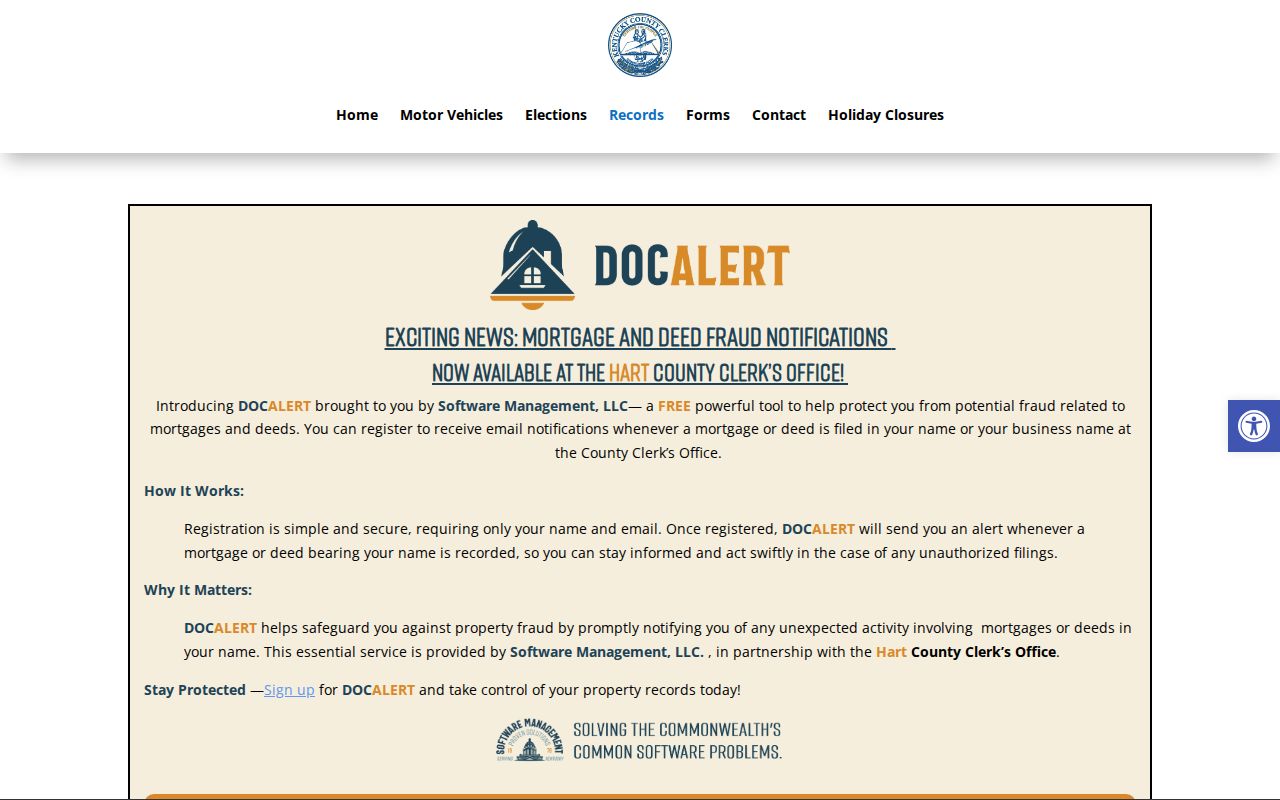
Check the county page for current Doc Alert enrollment details and recording fees.
Hart Deeds After the Fire
Hart County's 1928 courthouse disaster changes what an empty search means. The Kentucky Department for Libraries and Archives documents the event. Its county inventory lists Hart deeds from 1928 through 1998 in state archival holdings. So a pre-fire gap may reflect what survived the flames. It may not reflect whether a transfer ever happened. A missing deed is not the same as a missing transaction.
Local sources help fill the hole. The Hart County Historical Society Museum keeps genealogy materials and surname files. Its fire history notes that deeds were among the lost courthouse material. Local historian Roy Cann spent years reproducing records by hand. Treat museum copies, abstracts, and transcripts as derivative material. Check them against any surviving Clerk, KDLA, tax, probate, or court source before relying on them.
Order a Hart County Deed
Start with the online index if the required account access is available. No account? Go to the Clerk's counter instead. Bring the party names, an approximate recording date, the instrument type, and the legal description. Staff may need a book and page for a mail request. A quick phone call can confirm this first. For a formal public-records route, file the Clerk's open-records form. Ask which option fits best: inspection, an electronic scan, a plain paper copy, or a certified copy.
Older documents may sit in the state archive instead. For those, use the KDLA records-request service. Its research categories cover both deed and probate requests. Stated processing runs four to six weeks. FamilySearch full-text search, the Hart Museum, and the Hart County Public Library can help pin down names and dates. Still, access limits or a local copy never replace the official recording.
Recording is not a title opinion. The index shows filed instruments, while unrecorded interests, later corrections, releases, and court orders may still affect title.
Ask for the complete instrument, all pages included, not just the index row. Note the source and the retrieval date. For tracing ownership backward, the separate Hart County former-owner trail keeps that chain distinct from ordering a single deed.